

It is 2:40pm, the next call starts in five minutes, and the corner store by the office has a cooler of small bottles promising a sharper brain. BrainJuice is built for exactly that moment: twist the cap, drink 2.5 ounces, get back to work. Numin is built for the hour after that, and the one after that.
Both are sold as brain support rather than energy, and both lean on amino acids and plant extracts instead of a big dose of caffeine. They still answer different questions. BrainJuice asks how quickly you can feel clearer. Numin asks whether your judgment at 4pm can match your judgment at 10am. Feeling alert and deciding well are separate things, and most of this comparison turns on that difference.
Rival figures below come from BrainJuice's own store, FAQ and Supplement Facts panels, checked November 3, 2026. We make Numin, so check the attributions.
Our verdict
The verdict: Numin vs BrainJuice
Our pick for the decisions that slip by 4pm
It depends on whether you need to feel a lift now or to keep your judgment steady for the rest of the day.
Numin
Wins 2, ties 2 of 6
BrainJuice
Wins 2, ties 2 of 6
For a brain juice shot you can drink on the way into a meeting and feel within minutes, BrainJuice is the more convenient choice. It comes caffeinated or decaf, needs no water or stirring, and the maker says most people notice it in 5 to 10 minutes. That is a real advantage, and Numin does not try to match it.
If your problem is that decisions get worse as the afternoon goes on, Numin is the better fit: the only one of the two with its own published trial, one that counted decision errors, and it has no caffeine to wear off or to keep you up. Our scores are editorial ratings out of 10, weighted toward that afternoon. For it, the Numin Decision Fatigue Supplement is one stick in water, 30 to 60 minutes after lunch.
Numin & BrainJuice at a glance
Two drinks built for two different moments
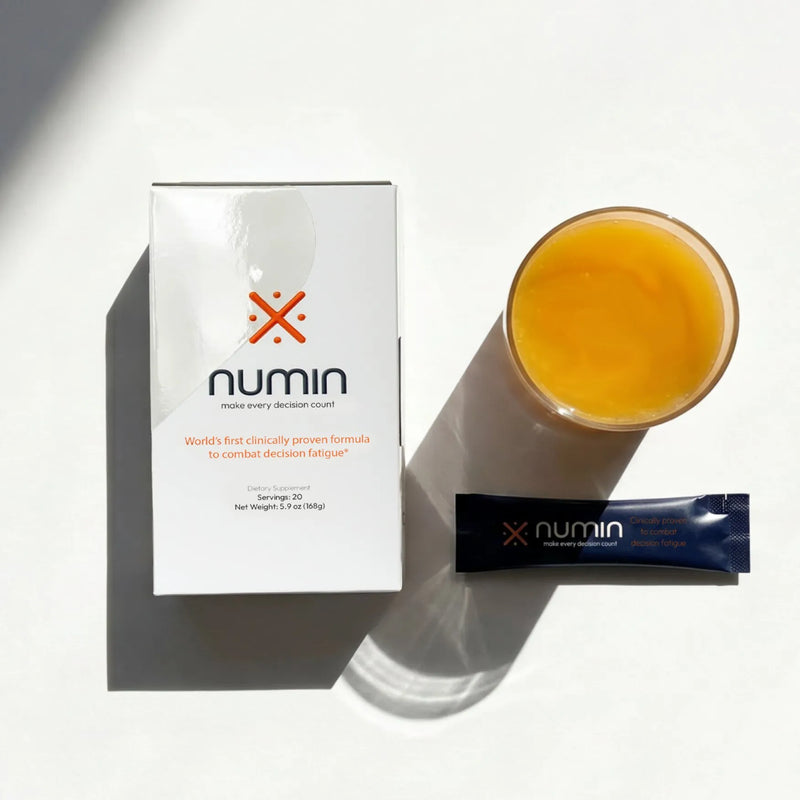
BrainJuice is a family of products: 2.5 oz shots, 12 oz cans, a Daily BrainPower Mix powder, BrainWater and BrainJava coffees. Here is the BrainJuice Original Classic shot, the brand's best-known nootropic drink, next to Numin.
Side A
Numin decision fatigue drink
$80 / 20-pack
Five named ingredients in a soft citrus stick, mixed in water once a day after lunch. No caffeine, no sugar. Most people notice it within about 60 minutes, and performance held at baseline for 6+ hours in Numin's trial.
Shop NuminSide B
BrainJuice brain juice shots
$53.88 / 12 shots on brainjuice.me
A 2.5 oz ready-to-drink shot with B vitamins, vitamin C and a 950mg BrainPower Blend including alpha-GPC, L-tyrosine, L-theanine and 75mg of green tea caffeine. Decaf versions exist. 10 calories. Price as of November 3, 2026.
How Numin & BrainJuice score
Six criteria, scored out of 10
Most brain drink reviews count ingredients. We score what each product does for the second half of a working day, and how you know. Six criteria, each from 0 to 10. Read this as a BrainJuice review written by the company that makes the alternative.
Clinical evidence on decision quality
Numin wins Numin 7 · BrainJuice 3
Numin is the only one of the two with a published trial of its own: a randomized, placebo-controlled crossover pilot published in Frontiers in Nutrition. Numin reports 43% fewer decision errors than placebo; read Numin's peer-reviewed clinical trial for the design. It loses points because it was one company-funded trial in 23 competitive gamers, and the decision fatigue scale and nine cognitive tests were not statistically significant.
BrainJuice explains its formula through the science of neurotransmitter production, and several of its ingredients have their own research. We found no trial of the BrainJuice product on its store or FAQ. That is a gap in what is published, not proof that it does nothing.
Stimulant-free & daily-use friendly
Numin wins Numin 9 · BrainJuice 6
Numin has no caffeine, sugar or stimulants and is meant to be taken daily. BrainJuice's original line carries 75 to 111mg of caffeine, which is moderate, and the maker caps use at two bottles a day. The decaf shots narrow the gap a lot. The score reflects the line most people pick up first.
Ingredient transparency
Tie Numin 5 · BrainJuice 5
A tie, and not a flattering one. Both list their vitamins and minerals with amounts. Both put their functional ingredients in a blend with no per-ingredient doses: 950mg in BrainJuice, 5.85g in Numin. BrainJuice does not print its caffeine milligrams on the panel; the 75mg figure comes from its FAQ.
Onset & duration
BrainJuice wins Numin 7 · BrainJuice 8
BrainJuice says most users notice it within 5 to 10 minutes and that the effects last six to eight hours. Those are the maker's figures rather than trial results, but a caffeinated shot is felt fast, so this round goes to BrainJuice.
Numin says most people notice it within about 60 minutes, and in its trial performance held at baseline for 6+ hours from one serving. What you notice is different: not a kick, but an afternoon that does not fall away.
Format & taste
BrainJuice wins Numin 6 · BrainJuice 8
A 2.5oz shot needs no water, no glass and no stirring, comes in several fruit flavors and sits in grocery coolers. Numin is a soft citrus stick you mix into water, which takes a minute and a glass. We do not score taste, which is personal; on format, BrainJuice wins.
Price per serving
Tie Numin 6 · BrainJuice 6
At the time of writing, BrainJuice shots are $53.88 for 12 on the brand's store, about $4.49 each, or about $3.82 on its subscribe and save option at 15% off. Its Daily BrainPower Mix is $39.99 for 15 servings, about $2.67.
Numin is $4.00 a stick one-time, $3.00 on subscription after a $40 first order, and $3.33 or $2.50 a serving in the 30-serving pouch. Shot for stick, the two land close; the powder mix is cheaper than either.
Brain juice ingredients vs Numin's five
What is actually in each serving
Start with the label, because brain juice ingredients are where the two look most alike. Per serving:
- BrainJuice Original Classic, 1 bottle (74mL): vitamin C 20mg, vitamin B6 10mg (588% DV), vitamin B12 50mcg (2083% DV), pantothenic acid 15mg (300% DV), sodium 5mg, and a 950mg "BrainPower Blend" of alpha-glyceryl phosphoryl choline (alpha-GPC), acetyl-L-carnitine, acerola cherry, caffeine from green tea extract, green tea leaf, acai, L-tyrosine, wild blueberry and L-theanine. Sweetened with coconut sugar and monk fruit, 2g sugar.
- Numin, 1 stick: chromium (as chromium picolinate) 400mcg at 1143% DV, sodium from Himalayan pink salt 40mg, and a 5.85g Numin Decision Blend listing MSM, L-tyrosine, Rhodiola rosea root extract (3% rosavins, 2% salidrosides) and Curcugen turmeric extract. Sweetened with stevia, no sugar.
They overlap once, on L-tyrosine. Beyond that the designs differ. BrainJuice describes its formula as building blocks for neurotransmitters, mainly acetylcholine and dopamine: alpha-GPC supplies choline, and tyrosine is a dopamine building block, with B vitamins on top. Numin's formula is built around one problem: it supports the brain's natural glutamate clearance system, so that decision quality holds at baseline rather than being pushed above it. You can read why each one is there in the five ingredients in Numin.
What neither label tells you is the dose of any functional ingredient inside its blend. BrainJuice lists 950mg in total (880mg in the decaf version) without amounts per ingredient, and Numin lists 5.85g in total the same way. Both state their vitamins and minerals one by one. So you cannot hold either product up against a single-ingredient study and check the dose. That is a limit for both, not a point for either.
Caffeinated, decaf or caffeine-free drinks
How much caffeine you actually want
Caffeine is the clearest dividing line, and it is not as simple as caffeinated versus not. BrainJuice sells three levels: the Original and Immunity shots carry 75mg of green tea caffeine, which the maker compares to about half a cup of coffee; the Active shots carry 111mg; and the Decaf Classic and Decaf Peach Mango use decaffeinated green tea. Numin has no caffeine in any form.
For a sense of scale, the FDA guidance on daily caffeine cites 400mg a day as an amount not generally associated with negative effects for most adults, while noting that sensitivity varies widely. A 75mg shot sits well inside that. The questions are when you drink it and what else you drink that day. The same page notes that decaf coffee still has 2 to 15mg per cup, so decaf is low caffeine rather than none.
Scanning a cooler for caffeine free drinks? The honest split is this. A decaf shot removes the stimulant but keeps a formula aimed at alertness and mood. Numin removes the stimulant because its target is different: not how awake you feel, but how cleanly your prefrontal cortex is still signaling after hundreds of choices. Caffeine works on the first by blocking adenosine, the signal that reports tiredness. It does nothing for the second, which is why a well-caffeinated person can still make a careless call at 4pm.
Timing matters too. A 75mg shot at 3pm can still be partly in your system at bedtime, and a short night makes tomorrow's afternoon worse. Numin's guidance is one stick after lunch and nothing after 4pm, and Numin says there is no tolerance, dependency or rebound. For the ingredient picture beyond these two products, see brain drink ingredients without caffeine.
Who each one is best for
Pick by the problem you have
Most people looking for a focus drink are really choosing between a lift they can feel and steadier judgment they may only notice in hindsight. Here is how that splits.
Choose Numin if
- Your decisions get worse after lunch even when you feel awake enough.
- You want no caffeine at all, including in the afternoon.
- You want a published trial that counted decision errors, limits stated.
- You are happy to mix a stick in water once a day, after lunch.
BrainJuice might suit you if
- You want a focus shot you can drink in seconds with no mixing.
- You like a moderate caffeine lift, or want the same formula in decaf.
- You want to feel something within minutes, before a meeting.
- You prefer buying single bottles in a store over a subscription.
Neither is a substitute for sleep, a real lunch or moving your hardest calls into the morning. If tiredness is there when you wake, lasts through days off or comes with other symptoms, raise it with a clinician before you buy either.
BrainJuice pros & cons vs Numin
The honest trade-offs
Every nootropic shot or stick involves trade-offs. These are the ones we would want to know before buying.
Numin pros & cons
Pros
- Backed by its own published, placebo-controlled trial.
- No caffeine, sugar or stimulants; meant for daily use.
- Designed for the late afternoon, with 6+ hours from one serving in its trial.
- 30-day money-back guarantee on the first order.
Cons
- One trial, 23 people, funded by Numin's parent company; secondary measures not significant.
- Blend amounts are not disclosed.
- Slower to notice: about an hour, and no felt kick.
- Needs water and a minute to mix.
BrainJuice pros & cons
Pros
- Fast and convenient: a 2.5oz shot, no mixing.
- Caffeinated and decaf versions of the same base formula.
- Moderate caffeine (75mg) in the original shots, 10 calories.
- Widely sold in grocery and natural food stores.
Cons
- No trial of the product itself is cited by the maker.
- Blend amounts are not disclosed, including caffeine on the panel.
- Caffeinated versions can affect sleep if taken late.
- The brand does not accept returns or offer refunds.
Numin vs BrainJuice questions
Straight answers
The questions people ask most when comparing the two.
Is BrainJuice worth it?
It depends on what you want it to do. If you want a quick, convenient lift with a moderate dose of caffeine, or a decaf shot with B vitamins, BrainJuice delivers that in a format that is hard to beat. If you want evidence that it improves decisions later in the day, the maker does not cite a product trial.
Reading brain juice reviews? Keep in mind that the brand store showed a single review on the Classic shot on November 3, 2026, so most of what you will find lives on retailer pages. Check how recent they are.
Does BrainJuice have caffeine?
The original BrainJuice shots contain 75mg of caffeine from organic green tea, per the maker's FAQ; the Active shots contain 111mg. The Decaf Classic and Decaf Peach Mango shots use decaffeinated green tea, which still carries a trace, as decaf coffee does.
Can you drink BrainJuice & Numin on the same day?
Many people could, but space them out. Numin goes in 30 to 60 minutes after lunch and not after 4pm. Count the shot's caffeine against your day's total, and keep caffeine well before bed. Rhodiola, one of Numin's ingredients, has been flagged by Memorial Sloan Kettering as possibly adding to a stimulant's effect on blood pressure, though the clinical relevance is unclear. If you take medication, have high blood pressure, or are pregnant or nursing, ask your doctor first.
Which works faster, a focus shot or Numin?
A caffeinated focus shot is faster to feel: BrainJuice says 5 to 10 minutes. Numin takes about 60 minutes to start and is meant to prevent a decline rather than produce a lift, so the honest comparison is speed against staying power. In Numin's trial, performance held at baseline for 6+ hours from one serving.
Our pick
For the second half of the day, our pick is Numin
One stick in water, 30 to 60 minutes after lunch, no caffeine to wear off. Numin is a dietary supplement, not a treatment for any condition; if you take medication, are pregnant or nursing, check with your doctor first.
Shop NuminMore on decision fatigue & brain fog
Keep reading
The Science
Coffee wakes you up. It doesn't make you decide better
Coffee vs cognitive support: caffeine blocks sleepiness but doesn't improve decisions. Learn about tolerance, the 3pm cliff and how to use both.
 Dr. Shawn Watson ·
Decision Frameworks
How to quit caffeine & keep your edge
How to quit caffeine without a week of fog at your desk: count your real intake, drop the afternoon cup, taper slowly and plan around the withdrawal dip.
Dr. Shawn Watson ·

Decision Fatigue
Feeling sharp vs being sharp: Why your brain can't grade its own decisions
Feeling clear-headed and making clear-headed decisions aren't the same thing. Research suggests the brain's ability to judge its own performance can decline right alongside decision quality, without you noticing. Here's what the science says, and what it doesn't.
Dr. Shawn Watson ·