

The first coffee works. The second mostly works. By the third, at 2:30pm, you are drinking it out of habit, and the evening is a mix of wired and tired that makes the next morning's first coffee feel essential again. Many people who want energy without stimulants are not trying to quit caffeine on principle. They are tired of the loop.
This guide is about getting off that loop without a crash. It starts with the step most people skip, finding out why you are tired, then walks down the caffeine slowly and replaces it with things that work with your body clock instead of against it. Supplements, including the one we make, come late and with their limits stated.
What you'll need to boost energy without stimulants
Three weeks & a bit of patience
Stepping down from stimulants is slow on purpose. Plan for about three weeks before you judge the result.
- A fatigue diaryWhen you feel tired, when you feel good, what you ate, how you slept.
- Your current caffeine totalEvery coffee, tea, soda and energy drink, for three normal days.
- Caffeine-free swapsDecaf, herbal tea, sparkling water: whatever you will actually drink.
- Daylight & a walking routeTen minutes outside in the morning and again after lunch.
Find out why you're tired before you buy anything
Rule out the reasons you cannot fix with a drink
Tiredness is a symptom, not a diagnosis. MedlinePlus on fatigue causes lists a long range of them: thyroid and other chronic diseases, anemia, sleep apnea and other sleep disorders, depression and anxiety, infections and certain medicines, alongside everyday ones such as short sleep, alcohol, too much caffeine and too little or too much exercise.
It also offers two practical steps. Keep a fatigue diary to see when you feel worst and best. And if fatigue does not get better after several weeks, call your provider. A blood test that finds low iron is worth more than any energy product, and no supplement should stand in for that check.
Step down from stimulants slowly
Cut caffeine by a little each week
Stopping caffeine abruptly is the fastest way to feel worse. A 2004 review by Juliano and Griffiths, covering 66 studies, found that withdrawal brings headache, fatigue, drowsiness, difficulty concentrating and feeling foggy, usually starting 12 to 24 hours after the last dose and lasting 2 to 9 days. It appeared even after stopping doses as low as 100mg a day. In other words, quitting cold can create the very brain fog you are trying to clear.
The FDA's advice is to cut back gradually; it notes that withdrawal is not considered dangerous but can be unpleasant. A workable plan is to remove one caffeinated drink, or half a cup, each week, starting with the latest one in the day. Replace it with caffeine free drinks you like, such as herbal tea or sparkling water. Decaf counts as a step down rather than zero, since the FDA puts decaf coffee at 2 to 15mg a cup.
For why the third coffee stops doing much, read about caffeine tolerance and false energy.
Tip
Swap the afternoon coffee first. It does the most damage to sleep and the least for your morning.
Use natural energy boosters at the right hour
Light in the morning, a walk at 2pm
The most reliable natural energy boosters are free and depend on timing. Morning daylight and a fixed wake-up time help set your body clock; MedlinePlus lists both among its habits for healthy sleep, which is where tomorrow's energy comes from.
Then there is the afternoon slump. It is real: a 2005 review by Timothy Monk described a mid-afternoon dip in alertness that is part of the body's daily rhythm and can happen even without lunch. That makes 2pm the right hour for a ten-minute walk, ideally outside, rather than a coffee that will still be with you at bedtime. Why you hit an afternoon wall covers more of the cause.
Pick a non-stimulant supplement for brain fog
A supplement without a stimulant
Non stimulant energy supplements do not give you a jolt, and the honest ones do not promise one. Their claims are smaller, and so is their evidence. Here is how the main supplements for energy and brain fog stand.
- Rhodiola rosea: the best studied herb for mental fatigue. In a 2009 trial by Olsson and colleagues, 60 adults with stress-related fatigue took 576mg of an extract a day or placebo for 28 days; the rhodiola group did better on burnout scores and some attention measures. A 2012 review by Ishaque and colleagues found the evidence across 11 trials contradictory and at high or unclear risk of bias.
- Creatine: research on creatine for brain fog is early. A 2018 review of six trials with 281 people found possible gains in short-term memory and reasoning, with conflicting results for mental fatigue.
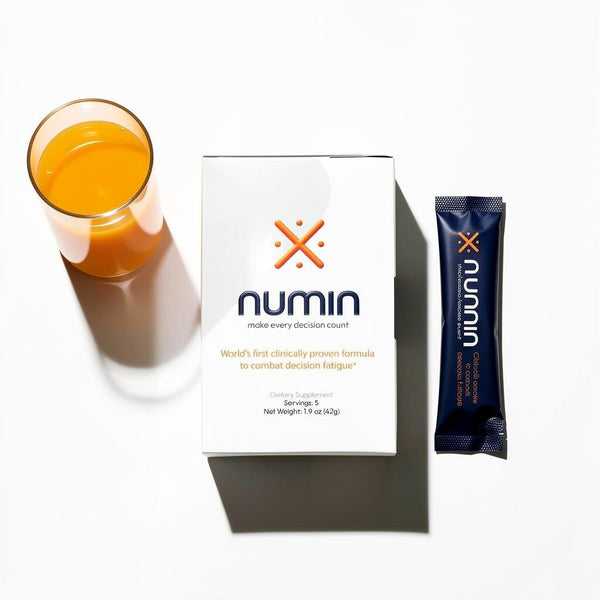
Numin, which we make, is built around a stimulant-free formula of five named ingredients: chromium, MSM, L-tyrosine, a rhodiola rosea root extract standardized to 3% rosavins and 2% salidrosides, and Curcugen turmeric extract. It supports the brain's natural glutamate clearance system, aiming to keep decision quality at baseline through the afternoon rather than lift you above it. Numin reports 43% fewer decision errors than placebo in its trial, a randomized, placebo-controlled crossover pilot. The limits: one trial, 23 competitive gamers, funded by Numin's parent company, with the decision fatigue scale and nine cognitive tests not statistically significant.
Numin's rhodiola rosea formula has no caffeine or sugar: one stick in water, 30 to 60 minutes after lunch, and not after 4pm. Rhodiola can interact with some medicines, so check with your doctor first if you take any, or if you are pregnant or nursing.Eat & move for steadier energy
Food & movement that keep you level
How to get energy without caffeine mostly comes down to what you eat at lunch and whether you move afterward. Monk's review found that a high-carbohydrate lunch makes the afternoon dip worse, so build lunch around protein and vegetables, with a smaller share of bread, rice or pasta, and keep the portion moderate.
Movement helps on two timescales. In the moment, a 2012 meta-analysis by Chang and colleagues found a small positive effect of a single bout of exercise on cognitive performance. Over weeks, MedlinePlus lists regular physical activity among its first steps for managing fatigue, while warning that too much exercise can be a cause too. Water belongs here as well; thirst is easy to miss at a desk.
For ingredients that support focus without a stimulant, see brain performance without caffeine.
Stimulants vs non-stimulants for brain fog
Borrowed energy vs steadier energy
Stimulants and non-stimulants solve different problems, and both have a place.
- Stimulants, mainly caffeine: fast, felt within the hour, good for alertness. The cost is tolerance, sleep if taken late, and withdrawal fog if you stop suddenly.
- Non-stimulants, such as rhodiola or Numin: slower and without a jolt, so there is nothing to come down from. The cost is weaker, more mixed evidence and effects you may only notice in hindsight.
Most people do best with a little of both: a moderate morning coffee, no caffeine after lunch, and the habits in this guide doing the heavy lifting. Numin says there is no tolerance, dependency or rebound with its formula.
How to boost energy naturally, day by day
A day with energy that does not crash
Put together, here is how to boost energy naturally across a normal workday:
- On waking: the same wake-up time every day, daylight within the first hour, water before coffee.
- Morning: one moderate coffee or tea if you want it, with breakfast.
- Lunch: protein and vegetables first, a moderate portion, then a ten-minute walk outside.
- 2pm to 4pm: no caffeine. Water, a short break between tasks, and if you use Numin, the stick after lunch.
- Evening: no caffeine, alcohol well before bed, and a bedtime that leaves 7 to 9 hours.
That is how to boost energy without borrowing it: fewer peaks, fewer crashes. If you follow it for a few weeks and are still exhausted, go back to step one and book that appointment.
Energy & brain fog questions
Straight answers
The questions people ask most about energy without caffeine.
How can you get energy without caffeine?
Start with a fixed wake-up time and morning daylight, eat a lunch built around protein and vegetables, and take a ten-minute walk in the early afternoon. Drink water through the day. These work with your body clock, cost nothing and do not leave a crash behind.
Do non-stimulant supplements work for brain fog?
Some may help, modestly. Rhodiola has positive trials for mental fatigue, though reviewers rate their quality poorly. Creatine's evidence is early. Numin's trial reported fewer decision errors, with the limits we describe above. None works like a stimulant, and none replaces sleep or a check-up for persistent tiredness.
Why does caffeine stop working?
Regular use builds tolerance, so the same cup does less. There is also a loop: a 2004 review by Juliano and Griffiths found that avoiding withdrawal plays a central role in why people keep drinking caffeine. Part of the morning lift is simply reversing the dip from not having had any since yesterday.
What clears brain fog fastest?
For most people, a glass of water and a ten-minute walk outside are the fastest options, and both have research behind them. Caffeine works quickly too but brings the costs above. Fog that does not lift with rest deserves a doctor.
More on decision fatigue & brain fog
Keep reading
Brain Fog & Mental Fatigue
How to clear brain fog fast, & what the “instant” fixes actually do
No fix answers how to clear brain fog instantly. Here is what cold, caffeine, walking and light really do, and the timescales that actually hold up.
 Dr. Shawn Watson ·

Work & Performance
Endurance is a decision problem, not just a fitness one
Every long effort is hundreds of pacing decisions. Michelle O'Brien on why cognitive load, not legs, often decides how the last third of a race goes.
Dr. Shawn Watson ·

The Science
Stimulants push your brain harder. Clearance support stops it overheating
Nootropics vs stimulants: stimulants push output above baseline, clearance support prevents decline. Learn the difference, tolerance and rebound.
Dr. Shawn Watson ·