

Search for glutamate and you will find two opposite stories. In one, it is a nutrient you should take more of. In the other, it is a toxin you should flush out. Neither is right, and both sell supplements.
Glutamate is the most common signaling molecule in your brain, used in most of the connections that let you think, learn and remember. It is also something your brain keeps on a short leash, because too much in the wrong place at the wrong time is a problem. This guide covers what glutamate does, what glutamate supplements actually contain, what raises and lowers it in the body, and where the evidence stops. It is information, not medical advice.
Glutamate in the brain: What it does
The brain's main go signal
The short answer to what is glutamate: it is an amino acid, one of the building blocks of protein, and also the chief excitatory neurotransmitter in the nervous system: the chemical one nerve cell releases to tell the next one to fire. Glutamate in the brain is estimated to be involved in around 90% of synaptic connections. For a plain-language overview, see what glutamate does day to day.
Glutamate function is mainly fast communication, but it also shapes how the brain changes. Glutamate receptors come in two broad families. Ionotropic receptors (AMPA, NMDA and kainate) open channels in the cell membrane within a fraction of a millisecond. Metabotropic receptors act more slowly, through chemical messengers inside the cell. NMDA receptors in particular are central to learning and memory, because they help strengthen the connections that get used.
Key idea
Glutamate is not good or bad. It is the brain's main go signal, and the brain spends a lot of effort keeping it where it should be.
Glutamate supplements & what they contain
What is in the bottle, & what reaches the brain
Glutamate supplements usually come in one of three forms:
- L-glutamic acid: glutamate itself, sold as a capsule or powder.
- L-glutamine: a related amino acid the body can convert into glutamate.
- Monosodium glutamate (MSG): not a supplement, but the most common added source. The FDA describes it as the sodium salt of glutamic acid.
A few facts put these in perspective. First, glutamate is a non-essential amino acid: your body makes enough of it on its own. Second, food already supplies a lot. The FDA estimates that an average adult takes in about 13 grams of glutamate a day from protein, against about 0.55 grams from added MSG. A capsule adds little to that.
Third, and most important for the brain, very little dietary glutamate gets in. The blood-brain barrier is essentially closed to glutamate, and its transport systems move glutamate out of the brain rather than in. A 2009 review by Hawkins put plasma glutamate at 50 to 100 micromoles per liter and the fluid around brain cells at only 0.5 to 2. That gap is kept on purpose.
What raises glutamate levels
Work, signaling & injury
Inside the brain, glutamate rises and falls with use. Every excitatory signal releases a little into the gap between cells, where it is quickly cleared. Harder mental work means more signaling.
A 2022 study by Wiehler and colleagues in Paris tracked this across a workday. Volunteers did either demanding or easy mental tasks for several hours while researchers measured brain chemistry with magnetic resonance spectroscopy. By the end of the day, the demanding group had higher glutamate in the lateral prefrontal cortex, a region involved in cognitive control, and their choices had shifted toward quicker, lower-effort options. The authors proposed that the build-up makes effortful control more costly to use. It is one study, and an important one.
Injury and disease are the other cause. When the brain is injured or diseased, the transporters that handle glutamate can fail or run backward, and excess glutamate can damage cells, a process called excitotoxicity. That is a medical situation, not something a supplement causes or fixes.
What brings glutamate back into balance
The clean-up crew you already have
The body has its own systems for keeping glutamate in range, and they are fast:
- Transporters: proteins on nerve cells and on support cells called astrocytes rapidly pull glutamate out of the space between cells after its release.
- Recycling: astrocytes convert much of it into glutamine and hand it back to neurons, which turn it into glutamate again. This loop is the glutamate-glutamine cycle.
- The barrier: the blood-brain barrier moves glutamate out of brain fluid into the blood, keeping the fluid around brain cells at a tiny fraction of the level in blood.
More on the support cells in how astrocytes support mental clarity.
What helps them is mostly the ordinary things that let the brain recover: sleep, breaks from demanding work, and not stacking your hardest tasks at the end of a long day. The Wiehler study found the build-up after hours of demanding work, not easy work, which is one more argument for pacing.
Glutamate & GABA: The balance that matters
One molecule, two jobs
Glutamate and GABA are linked in a way many people do not expect. GABA, the brain's main calming or inhibitory messenger, is made from glutamate by an enzyme called glutamate decarboxylase. The brain's go signal is the raw material for its stop signal.
Healthy brain function depends on the balance between the two. The Wikipedia on the excitatory neurotransmitter entry describes both roles: the main excitatory transmitter, and the raw material for GABA. That is why simple stories about raising one or lowering the other fall short. The balance is set locally, moment to moment, by the brain itself.
"The brain does not want more glutamate or less. It wants the right amount, in the right place, for the right length of time."
Signs of a glutamate imbalance
Why online symptom lists mislead
Search for signs of a glutamate imbalance and you will find long lists: anxiety, poor sleep, headaches, brain fog, restlessness. Lists of high glutamate symptoms like these have three problems:
- They are nonspecific. Every item has many common causes, and none points to glutamate.
- There is no home test. A blood test does not show what is happening in the brain, because the blood-brain barrier keeps the two separate.
- Brain levels need a scanner. Brain glutamate can be measured with specialist scans, mostly in research.
Research does link glutamate signaling to several serious conditions, including stroke and some neurological diseases. That is a reason to see a clinician if you have persistent or worrying symptoms, not a reason to diagnose yourself from a list or to treat yourself with a supplement.
Glutamine vs glutamate
Similar names, different roles
Glutamine vs glutamate is a common mix-up, since the names differ by two letters. Glutamate is the signaling molecule. Glutamine is a related amino acid that acts as a safe storage and transport form: in the brain, support cells convert glutamate into glutamine, and neurons convert glutamine back into glutamate using an enzyme called glutaminase.
That is why L-glutamine is sometimes sold as a brain supplement. But the brain makes and recycles its own, and we know of no good evidence that taking L-glutamine changes glutamate signaling in the brains of healthy people. Ask your doctor before taking it for any health reason.
How Numin supports glutamate clearance
Support for a system, not a flush
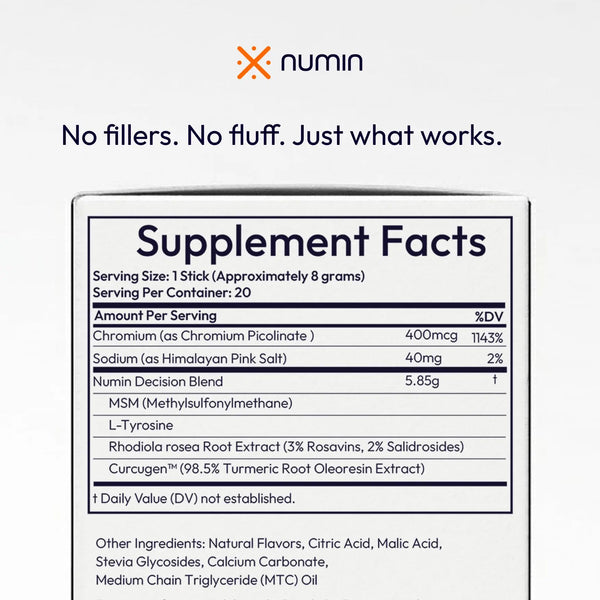
Numin takes the opposite approach to a glutamate supplement. It does not add glutamate. It supports the brain's natural glutamate clearance system, aiming to prevent a decline from baseline in the afternoon rather than push performance above it. Numin describes the role of one ingredient, Curcugen turmeric extract, as glutamate clearance, and the formula combines five named ingredients: chromium, MSM, L-tyrosine, rhodiola root extract and Curcugen.
In Numin's peer-reviewed clinical trial, a randomized, placebo-controlled crossover pilot, Numin reports 43% fewer decision errors than placebo. The limits matter: one trial, 23 competitive gamers, funded by Numin's parent company, with the decision fatigue scale and nine cognitive tests not statistically significant. The outcomes Numin reports are about performance and decisions, not glutamate levels.
The Numin Decision Fatigue Supplement is a dietary supplement, not a treatment for any condition. One stick in water, 30 to 60 minutes after lunch, not after 4pm. If you take medication or are pregnant or nursing, ask your doctor first.
Glutamate supplements questions
Straight answers
The questions people ask most about glutamate supplements.
What foods are high in glutamate?
According to the FDA, foods high in glutamate include tomatoes and cheeses, seaweed broth, and ingredients such as yeast extract, soy extracts and hydrolyzed vegetable protein. Any protein-rich food also releases glutamate when it is digested. Dietary glutamate is used by the body and largely kept out of the brain.
Is MSG the same as glutamate?
Chemically, yes. The FDA explains that MSG is the sodium salt of glutamic acid, and that the free glutamate released when you digest protein is the same molecule as the glutamate in MSG. The FDA considers MSG generally recognized as safe; some sensitive people report mild, short-lived symptoms after large amounts without food.
Does NAC affect glutamate?
N-acetylcysteine (NAC) is used in medicine for acetaminophen overdose and to thin mucus. It has also been studied in research settings for effects on glutamate signaling, and most NAC glutamate research looks at specific medical conditions, with mixed results. It is not a general brain supplement. Talk to a doctor before taking it.
Should you check with a doctor before taking a glutamate supplement?
Yes. Your body makes all the glutamate it needs, food supplies plenty more, and the brain tightly controls its own levels. If you are considering a glutamate or glutamine supplement for a symptom, a doctor can look for the actual cause. Take the same care with any supplement if you have a medical condition, take medication, or are pregnant or nursing.
More on decision fatigue & brain fog
Keep reading

Decision Fatigue
Is decision fatigue real? What survived the replication crisis
Is decision fatigue real? Ego depletion largely failed to replicate. Learn what held up, the neurochemical evidence and where new trials fit.
 Dr. Shawn Watson ·

Brain Fog & Mental Fatigue
Brain fog after eating: Why the hour after lunch is your worst thinking window
Brain fog after eating is common in the hour after lunch. Learn the 3 causes of the post-meal dip, what a lower-fog lunch looks like and timing.
Dr. Shawn Watson ·
The Science
What “cognitive support” means on a supplement label, & what it should mean
Cognitive support on a supplement label is a regulatory permission, not proof. Learn what labels can claim and how to read the evidence.
Dr. Shawn Watson ·